Ball valve.
A circle inscribed in a square represents the ball-valve body. Quarter-turn operation makes ball valves the dominant emergency-shutdown choice on modern P&IDs.
Three drawings included on a new account.
How it's drawn.
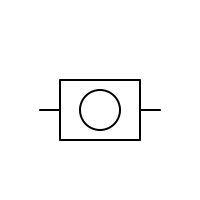
The body is drawn on the pipe run as a quarter-turn valve. The ball type itself is usually confirmed on the valve list rather than read from the body alone. What sits on top tells you how it is operated. A hand lever for manual service, a motor for a motor-operated valve, or a spring actuator. Quarter-turn operation is what makes it a fast open-or-shut block valve.
Typical usage.
ESD and emergency block service, full-port flow with negligible pressure drop, motor-operated valve, MOV bodies in liquid handling. Trim materials drive the cost. Full-bore stainless ball valves are the workhorse on hydrocarbon service.
Telling it apart.
- The body alone rarely proves the valve type. Confirm it against the valve list or read the actuator and any note.
- Quarter-turn does not mean on, off only. A ball valve with a positioner and a control actuator can throttle, even though it reads like a block valve.
- A circle drawn at the valve body is part of the valve, not an instrument bubble. An instrument bubble stands off the line on its own, with a tag inside.
Related.
Get the P&ID symbol cheat sheet.
One page of valve body shapes, so the ball valve is not read as a plug or a butterfly on the next sheet.