Butterfly valve.
An ellipse with a diagonal disc inside represents a butterfly valve. Compact, low-cost, suitable for large diameters where a globe or ball would be unwieldy.
Three drawings included on a new account.
How it's drawn.
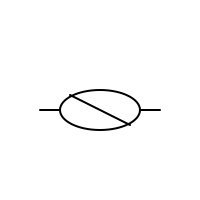
A round or elliptical body with a disc line across it, the disc that swings a quarter turn to open or close. It is compact for large diameters where a globe or ball body would be bulky. An actuator drawn on top, a hand lever, a motor, or a spring, shows how it is driven.
Variants.
- Lugged body. Threaded inserts let either flange be removed without taking the valve apart.
- Wafer body. Clamped between flanges with through-bolts. Lower cost, both flanges must be removed for service.
- Resilient-seated, rubber-lined. Water and low-pressure utility, soft shutoff to bubble-tight on clean fluids.
- High-performance, double-offset. Disc rotates off-axis, reduces seat wear, suitable for higher pressure and modulating service.
- Triple-offset metal-seated. Tight shutoff in steam and refinery service, meets API 598, API 6D Class VI.
- Actuator options. Hand lever, gear operator, electric, pneumatic scotch-yoke, hydraulic.
Typical usage.
Cooling water headers, large-diameter air or low-pressure service, HVAC-style isolation. Tight shutoff at high differential pressure is harder than with a ball valve, so butterflies usually aren't picked for ESD service.
Telling it apart.
- Butterfly and ball are both quarter-turn. The body outline and the disc line distinguish the butterfly.
- Lugged and wafer bodies look similar on the drawing. The difference is in how the body mounts between flanges, often carried as a note.
- A butterfly used for control carries a positioner and actuator, the same as any modulating valve.
Common questions
When is a butterfly valve preferred over a ball or gate valve.
Is the symbol the same for hand-actuated and automated butterfly valves.
How does a P&ID indicate whether a butterfly valve is open or closed.
Are butterfly valves rated for SIS, ESD service.
Related.
Get the P&ID symbol cheat sheet.
One page of valve body shapes, including the butterfly against the ball and plug bodies drawn beside it.