RTD sensor, Pt100, Pt1000.
TE, RTD inside an instrument circle. Resistance temperature detectors are the dominant primary element below 600 °C because they drift less than thermocouples and offer better accuracy.
Three drawings included on a new account.
How it's drawn.
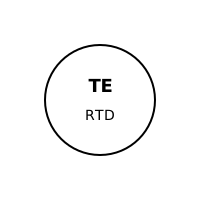
An instrument circle carrying TE, sometimes noted RTD, with the loop number below. Like any temperature element it sits at the process connection, usually inside a thermowell, and runs a line to its transmitter or indicator. The bubble looks the same as a thermocouple bubble. The element type is carried on the datasheet.
Typical usage.
Reactor jacket temperatures, BPCS regulatory loops, anywhere accuracy matters more than maximum operating temperature. 3-wire and 4-wire connections compensate for lead-wire resistance.
Telling it apart.
- An RTD bubble and a thermocouple bubble read the same on the drawing. The difference lives on the datasheet, not the symbol.
- TE is the element. TT is the transmitter. They are separate symbols joined by a signal line.
- The thermowell drawn at the wall is the pocket, not the sensing element inside it.
Related.
Read every symbol on the sheet.
TE, RTD inside an instrument circle. Resistance temperature detectors are the dominant primary element below 600 °C because they drift less than thermocouples and offer better accuracy.
Three drawings included on a new account.