Globe valve.
Two triangles meeting apex-to-apex form the standard globe-valve body symbol. Globe valves throttle flow well and dominate control-valve service because of it.
Three drawings included on a new account.
How it's drawn.
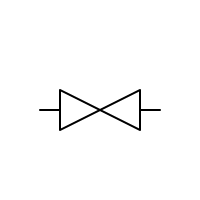
Two triangles meeting apex to apex, the bowtie valve body, with the throttling shape that suits control service. A rectangular bonnet on top usually means a diaphragm actuator, which is why the globe body is the default control-valve shape. With no actuator drawn on top it is a manual globe valve.
Typical usage.
The default body shape for control valves. When you see the bowtie body with a rectangular bonnet on top, you're looking at a pneumatic-diaphragm-actuated globe valve in BPCS service.
Telling it apart.
- The bowtie body is shared by several valve types. What sits on top tells you whether it throttles or just isolates.
- A globe body with a diaphragm bonnet is a control valve. A bowtie with a handwheel and stem is a manual valve, often a gate.
- Globe valves are built to modulate. A gate valve, drawn with a stem and handwheel, is meant to be fully open or fully shut.
Related.
Read every symbol on the sheet.
Two triangles meeting apex-to-apex form the standard globe-valve body symbol. Globe valves throttle flow well and dominate control-valve service because of it.
Three drawings included on a new account.