Knife gate valve.
A knife gate valve is drawn as a gate-valve bowtie body with a diagonal line marking the sharp gate blade. Like a gate valve it is an isolation device, fully open or fully closed, but the thin blade shears through the medium, which is why it is used on slurry, powder, and fibrous or viscous service.
Three drawings included on a new account.
How it's drawn.
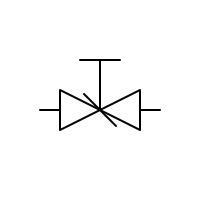
On a P&ID the knife gate reads as a gate-valve bowtie with a straight blade drawn across the body, the thin gate that shears through the flow. The blade is what separates it from a plain gate valve, but many drafting standards omit it, so the body type is confirmed from the valve schedule rather than the symbol. Actuation is shown the usual way: a bare stem for handwheel, a rectangle for a pneumatic cylinder, a filled circle for a motor operator.
Typical usage.
Isolation on slurry, wastewater, pulp and paper stock, mining tailings, and bulk-solids lines where a standard gate or ball valve would clog or fail to seat. It is not a control valve and is never paired with a positioner. On a P&ID it reads as a gate valve with the knife blade shown, so confirm the body type from the valve schedule rather than the symbol alone.
Telling it apart.
- A knife gate and a plain gate valve share the bowtie body; only the diagonal blade line distinguishes them, and it is frequently left off. Read the valve schedule, not the symbol, for the actual body type.
- It is an on/off isolation valve, never a control valve, so it is not paired with a positioner and does not carry an AO channel on the I/O list.
- A monitored knife gate with a limit switch (ZSO/ZSC) contributes a DI per switch to the I/O list; the valve body itself is not an instrument.
Common questions
How is a knife gate valve symbol different from a gate valve?
Is a knife gate valve a control valve?
Related.
Get the P&ID symbol cheat sheet.
One page of valve body shapes, including the knife gate against the plain gate it is most often confused with.