Magnetic flow meter.
A pipe section labeled MAG with a pair of inline electromagnetic coils. Magmeters work on conductive fluids and produce a clean linear signal without moving parts.
Three drawings included on a new account.
How it's drawn.
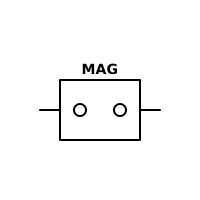
An inline pipe section marked as a magnetic meter, working on conductive fluids without moving parts. It produces a flow signal directly, so unlike a plate or venturi it does not need a separate differential-pressure element. Mounting is wafer between flanges on smaller lines or flanged on larger ones.
Variants.
- Wafer mounting. Clamped between flanges on lines from 1 inch up to about 4 inch.
- Flanged body. Standard line connection above 4 inch, lined and unlined options.
- Insertion, probe-style. Single-point measurement in large pipes where a full-bore meter is impractical.
- Sanitary, hygienic. Tri-clamp ends and FDA-compliant liners for food, beverage, and pharma service.
- Pulsed DC excitation. Current standard, low zero drift, immune to most process noise.
- AC excitation. Older technology, simpler signal conditioning, susceptible to slurry noise.
- Liner options. PTFE, PFA, hard rubber, polyurethane, ceramic. Chosen for chemical and abrasion resistance.
- Electrode materials. 316 stainless, Hastelloy C, tantalum, platinum-iridium for aggressive service.
Typical usage.
Water, slurry, conductive chemical service. Won't work on hydrocarbons, non-conductive. Maintenance-free in clean service. In slurry service the electrodes need periodic inspection.
Telling it apart.
- A magnetic meter works only on conductive fluids. It does not read non-conductive hydrocarbons.
- It outputs flow directly, so it does not need the differential-pressure transmitter that an orifice or venturi requires.
- Wafer and flanged versions differ in how the body mounts, usually carried as a note rather than a different symbol.
Common questions
What conductivity does a magmeter need to work.
Why will a magmeter not measure hydrocarbons.
Magmeter vs Coriolis. When to choose which.
What ISA 5.1 tag identifier does a magnetic flow meter use.
How much straight pipe does a magmeter need upstream and downstream.
Related.
Get the P&ID symbol cheat sheet.
One page of flow-element geometry, including the magnetic meter and the elements it is drawn next to.