A pilot on your own drawings.
One live project, read into the registers your team works from, every row traced to its sheet. Your engineers judge it on drawings they already know.
What a pilot is.
A pilot is one real project. You send the set your team is working on now, it is read in the tag convention its sheets use, and every read is marked on the drawing it came from. Your engineers work in the result instead of taking a spreadsheet on trust.
At the end you hold the registers, the redlined sheets and the exports, whatever you decide about working together after it. The workspace runs in the browser, and your team’s first task is the review.
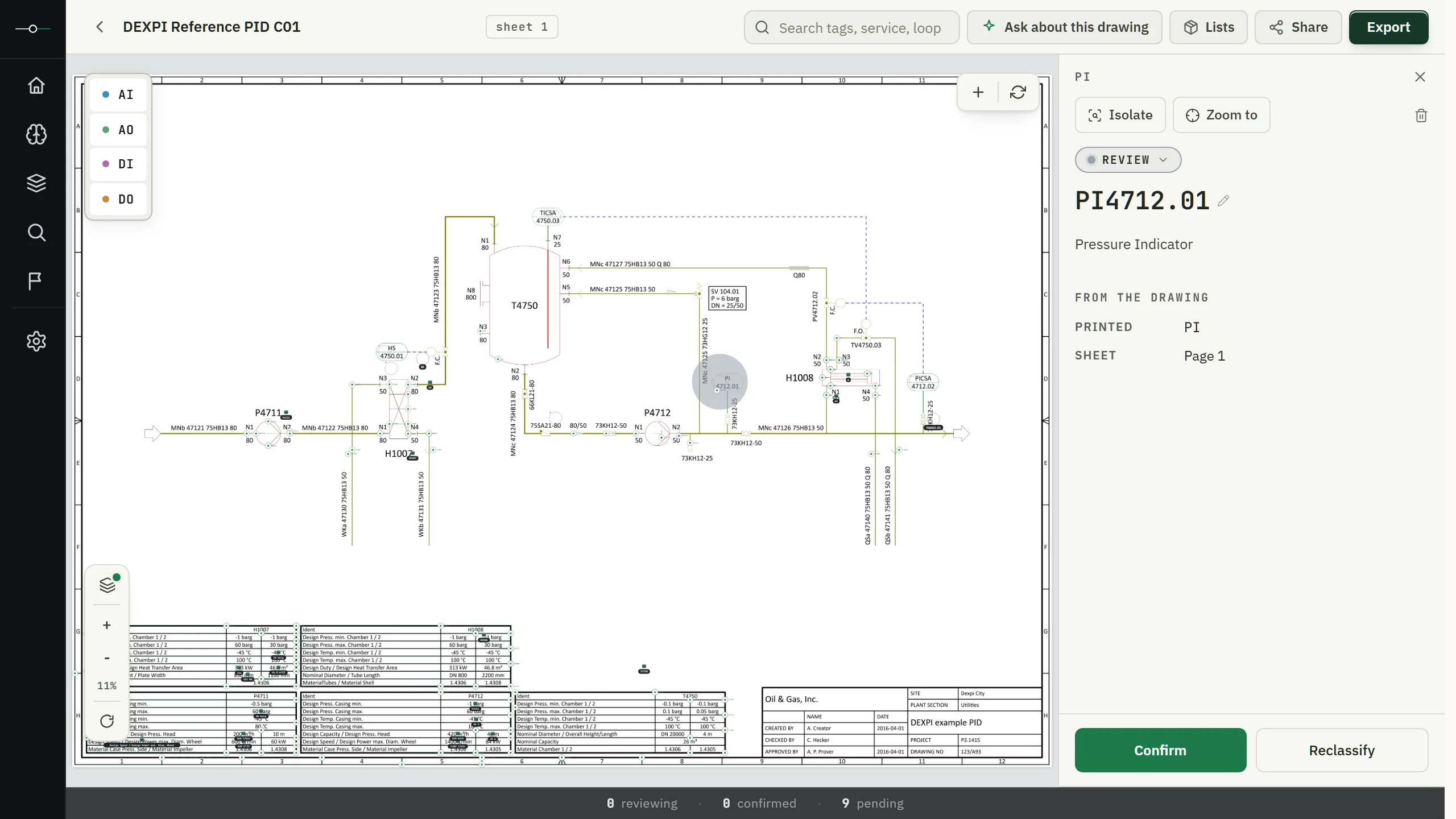
Every read, on the drawing it came from.
Your team reviews in the drawing itself. Each instrument is marked where it was read, its record sits beside the sheet, and your engineer can confirm or correct it there.
Who it is for.
You are at a design gate
EPC engineering department. The set is issued, the review is booked, and the instrument index behind it is still being typed out of the sheets by the people who should be checking them. The pilot puts a register in front of the gate instead of a backlog.
You are building the control system
System integrator. The card count, the panel layout and the cabinet schedule all come off an I/O list, and that list comes off drawings that keep moving. The pilot gives you the list, and the revised one when the drawings change.
You are digitising legacy drawings
Owner operator. The as builts are scans and paper, the plant runs on them, and the register a maintenance system needs has never existed. The pilot turns one area into a register you can check against the sheets it came from.
What you send, what you get back.
One set in. What comes back depends on the job.
You send
- One project’s drawing set, as PDF, scan or image
- The project name and the sheet numbering you use
- One engineer we can ask if a convention is ambiguous
You get back
- Instrument index Every instrument on the set, with the sheet and revision each one was read from.
- I/O list Signal class on every row, split between the basic control system and the safety system.
- Line list Lines with the service, size and spec the sheets carry for them.
- Asset register The register as load sheets for your maintenance system, IBM Maximo or SAP PM.
- Redlined drawings Each sheet marked up with what was read off it, so a reviewer checks the drawing, not a spreadsheet.
- Change report When the set is reissued, what changed against the one your team reviewed, tag by tag.
Request a pilot.
Tell us about the project, the drawings and the date you are working to.
Common questions
What counts as one project?
What do you need from us?
Do the drawings stay ours?
What happens after the pilot?
One project is enough to judge it.
Send the set your team is already working on and read the registers back against your own sheets.